
- No Australian bank sells you crypto - the question is whether it lets you move dollars to an exchange, and how much friction it adds along the way.
- Friendliest: NAB among the majors, plus challenger and neobanks like Up, ubank, Bank of Queensland and Great Southern. They generally allow transfers to AUSTRAC-registered exchanges with little fuss.
- Most restrictive: HSBC declines crypto payments outright, Macquarie stopped new transfers in 2024, and CBA, Bankwest and Westpac cap, hold or block. ING downgraded from friendly to difficult.
- The friction is sold as scam protection: Westpac says about a third of scam payments go straight to a crypto exchange.
- The bigger shift is regulatory: from April 2026 Australia requires crypto platforms to hold an AFSL, a reform partly designed to ease the debanking of legitimate exchanges.
The short answer
Every Australian bank has effectively the same crypto product: none. You cannot buy Bitcoin from your bank. What differs - and what actually affects you - is how each bank treats the payment when you move dollars from your account to an AUSTRAC-registered exchange to buy it yourself.
On that measure the market splits three ways. A friendly group waves registered-exchange transfers through on normal limits. A middle group allows them but adds caps, holds or selective blocks. And a restrictive group caps you hard, blocks named platforms, or declines crypto payments altogether. Here is the lay of the land before we get into each bank.
Posture as reported in mid-2026 for personal accounts transferring to AUSTRAC-registered Australian exchanges. Banks adjust these settings frequently and apply them inconsistently between customers - treat this as a starting point, not a guarantee.
Why your bank is the second gatekeeper
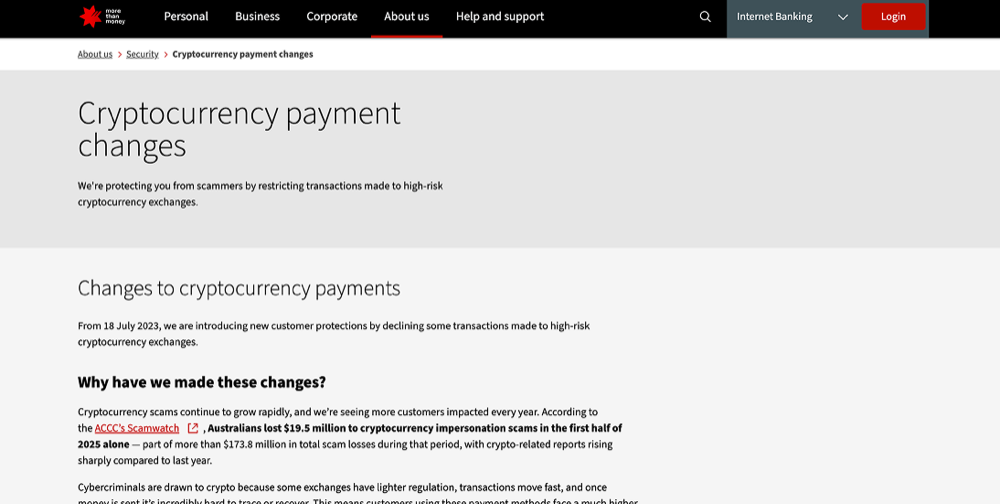
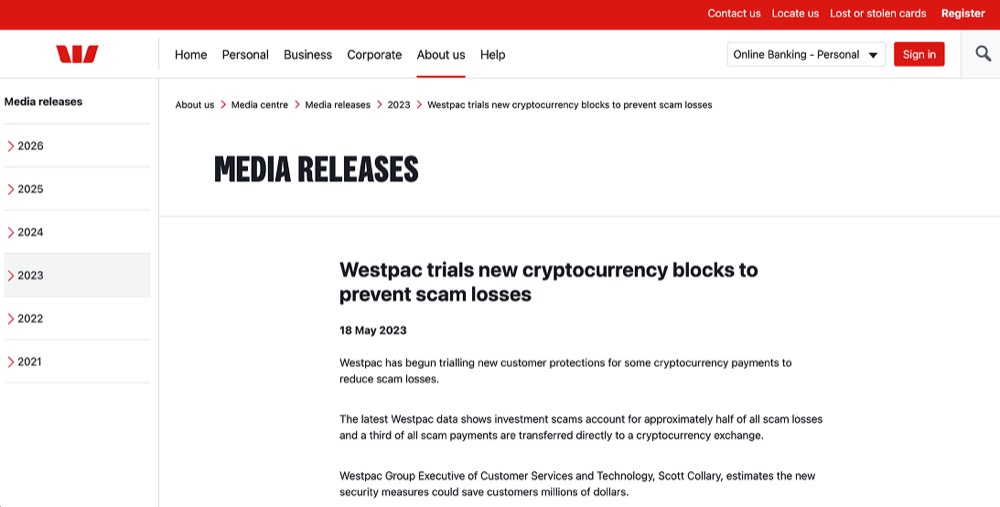
From 2023 onward, Australia's banks stopped being neutral payment rails for crypto. The trigger was scam losses. Westpac, announcing its blocks in May 2023, said investment scams made up roughly half of all scam losses, and that about a third of scam payments were going directly to a cryptocurrency exchange. The banks' response was to put friction between customers and exchanges: monthly caps, 24-hour holds, and outright blocks on platforms they classed as high risk - in practice, mostly offshore venues where clawing money back is near impossible.
The honest read is that this is genuine consumer protection bundled with genuine friction. Real scams are stopped; so are plenty of legitimate purchases. Two things follow for you. First, the bank you fund your exchange from matters - a transfer that sails through one bank gets held or declined at another. Second, the rules are a moving target, applied unevenly between customers and changed without much notice, so anything below is a snapshot to verify, not gospel.
The best crypto-friendly banks
These are the accounts that, as of mid-2026, tend to let you fund an AUSTRAC-registered exchange with the least drama. None of them is promising you anything - they simply apply less crypto-specific friction than the rest.
NAB - the most workable of the Big Four
NAB takes a blacklist approach rather than a blanket one: it approves payments to legitimate, registered Australian exchanges - CoinJar, CoinSpot, Swyftx and Coinbase among those commonly cited - and reserves its blocks for unregistered or higher-risk overseas platforms. Reported daily limits are generous (in the tens of thousands), with verification checks likely on your first transfer. If you want a Big Four bank and a smooth path to a local exchange, NAB is the pick.
ANZ - workable on the main account, locked down on ANZ Plus
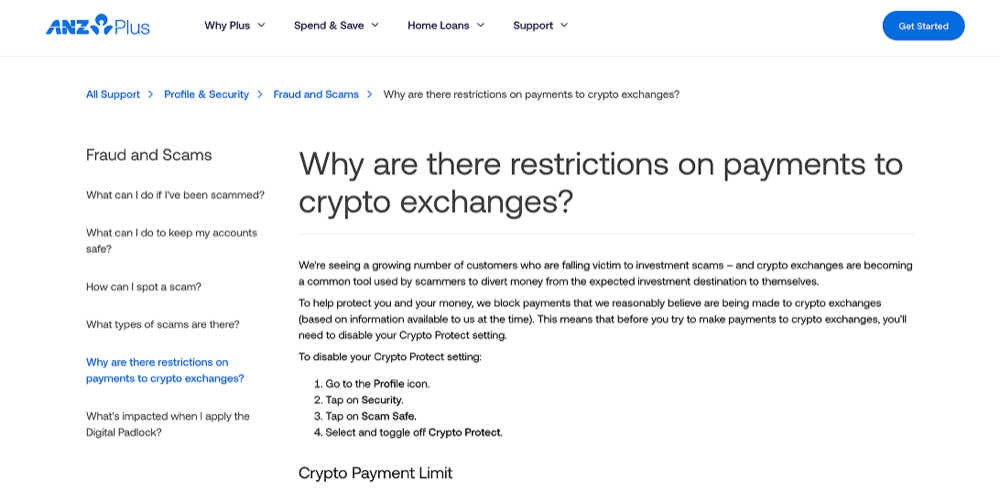
The standard ANZ account supports crypto transfers without a specific crypto cap, on normal pay-anyone limits, though a first or large transfer can attract a fraud hold of up to 72 hours, and a short list of platforms (Binance has been reported among them) can trigger a freeze. Note the split personality: ANZ Plus, the bank's app-only account, ships with a "Crypto Protect" setting that blocks exchange payments by default and caps them around A$10,000 a month once switched on. Same brand, very different experience.
Neobanks and challengers - the quiet achievers
The least friction often sits outside the majors. Up and ubank, Bank of Queensland, Great Southern Bank and Bank Australia are generally reported to allow PayID and Osko transfers to AUSTRAC-registered exchanges without crypto-specific caps, usually with nothing more than a verification check on a first or large payment. They run on the same real-time rails as everyone else, so deposits still land in seconds. The trade-off is smaller fraud teams and thinner public policy, so a large or unusual transfer can still get a phone call.
Revolut - crypto inside the app
Revolut is the outlier: rather than fighting you on transfers out, it offers crypto inside the app, with a large menu of tokens you can buy, sell and hold directly. That convenience comes with caveats - in-app spreads are wider than a dedicated exchange, you generally cannot withdraw to an external self-custody wallet on the same terms, and Revolut operates as an electronic money institution rather than a fully licensed Australian bank. Fine as an on-ramp; not a substitute for a real exchange if you want to control your own keys.
The most restrictive banks
At the other end are the accounts that cap you hard, block named platforms, or simply say no. If crypto access matters to you, these are the ones to fund around rather than through.
Commonwealth Bank and Bankwest - the A$10k handbrake
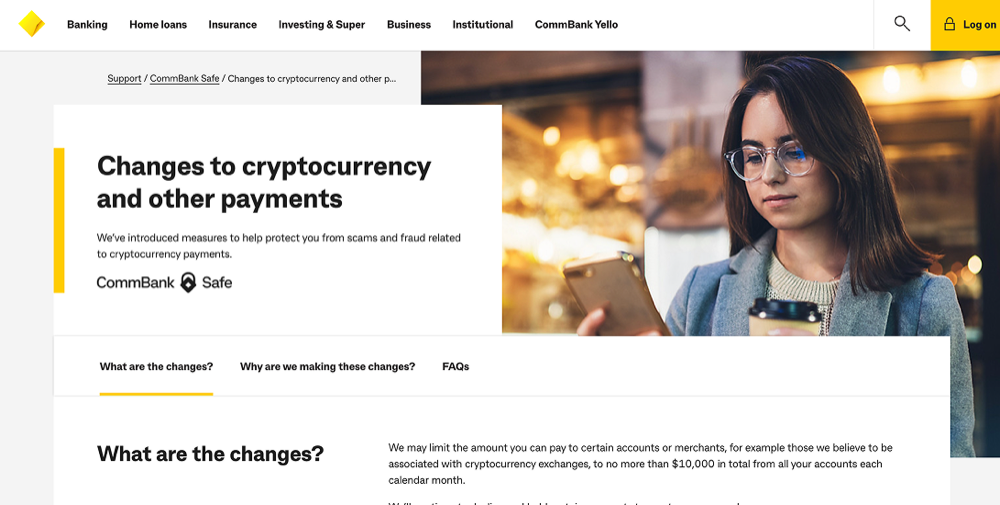
Australia's largest bank is also one of its most restrictive on crypto. In June 2023 CBA introduced a cap of roughly A$10,000 per calendar month on payments it identifies as going to crypto exchanges, across personal accounts, alongside 24-hour holds on some transfers and declines to platforms it deems high risk. Credit-card crypto purchases are blocked. Bankwest, which CBA owns, mirrors the same A$10,000 monthly posture. Payments to established local exchanges generally go through - you just live with the cap and the occasional hold. Our step-by-step guide to buying Bitcoin with CommBank walks the exact path around them.
Westpac - blocks by name
Westpac was first to move publicly, trialling crypto blocks in May 2023 and barring transfers to a number of exchanges, with Binance the headline name. Payments to well-established, AUSTRAC-registered platforms generally still process, but higher-value transfers can trigger a manual "SaferPay" review and delay, and offshore or unregistered venues are routinely stopped. Westpac's brands - St.George, Bank of Melbourne and BankSA - sit under the same group, though St.George in particular is often reported as more accommodating in practice. Treat that as customer-level luck, not policy.
HSBC and Macquarie - effectively closed
Two banks have gone furthest. HSBC Australia moved in mid-2024 to decline payments to crypto exchanges, citing scam losses and the difficulty of recovering funds. Macquarie stopped permitting new EFT transfers to cryptocurrency exchanges in late 2024 - if a payee was not already saved, the transfer will not go. For active crypto use, both are effectively closed doors.
ING - the cautionary downgrade
ING is the clearest example of why "friendly" is never permanent. Long a popular choice for crypto-buying Australians, it tightened sharply from 2024: deposits over about A$1,000 met with one to two business-day delays, and reports of specific platforms - CoinJar and Kraken among them - being blocked. A bank that works for you today can change its settings tomorrow, which is the single most important caveat in this entire guide. AMP sits in the same bucket, having stepped back from supporting crypto buying and selling.
Every major bank, compared
The full picture in one place. "Posture" is the overall stance for personal accounts moving money to AUSTRAC-registered Australian exchanges; limits and blocks are as reported in mid-2026 and change frequently.
| Bank | Posture | Cap to exchanges | Notable friction |
|---|---|---|---|
| NAB | Friendly | High daily limits | Blacklists unregistered overseas platforms |
| Up / ubank | Friendly | Standard limits | Verification on first/large transfer |
| Bank of Queensland | Friendly | Standard limits | Few crypto-specific blocks |
| Great Southern Bank | Friendly | Standard limits | Minimal; verification only |
| Revolut | In-app | In-app trading | Wider spreads; limited self-custody |
| ANZ (main) | Case-by-case | Standard limits | 72h hold on first transfer; blocks Binance |
| ANZ Plus | Case-by-case | ~A$10k / mo | "Crypto Protect" off by default |
| St.George (Westpac) | Case-by-case | General limits | Group blocks may apply; varies by customer |
| Commonwealth Bank | Restrictive | ~A$10k / mo | 24h holds; declines high-risk; credit blocked |
| Bankwest (CBA) | Restrictive | ~A$10k / mo | Mirrors CBA; credit blocked |
| Westpac | Restrictive | Dynamic review | Blocks Binance & offshore; manual holds |
| ING | Restrictive | A$1k+ delayed | Blocks platforms incl. CoinJar, Kraken (since 2024) |
| Macquarie | Restrictive | No new transfers | New EFT to exchanges blocked (late 2024) |
| HSBC | Restrictive | Declined | Declines crypto exchange payments (since 2024) |
| AMP | Restrictive | Unsupported | Stepped back from crypto buying/selling |
Limits are indicative and applied inconsistently between customers; several are informal fraud thresholds rather than published caps. Always confirm the current rules with your bank before moving funds. Coindaily is not affiliated with any institution listed.
The regulatory climate: AFSL, AUSTRAC and debanking
Bank friction is the symptom; the cause is that, until recently, Australian crypto platforms sat in a regulatory grey zone. That changed in 2026, and it matters for banking access.
The baseline has long been AUSTRAC. Any business converting dollars to crypto must register with AUSTRAC as a digital currency exchange provider and meet anti-money-laundering and counter-terrorism-financing obligations. That is the registration the word "AUSTRAC-registered" refers to throughout this guide, and it remains the first box any reputable Australian exchange ticks. But AUSTRAC registration is an AML formality, not a financial-services licence - it says nothing about how a platform must hold your money or treat you as a customer.
That gap is what the new framework closes. The Corporations Amendment (Digital Assets Framework) Bill 2025 passed Parliament on 1 April 2026 and received Royal Assent on 8 April. It creates two new regulated categories - digital asset platforms and tokenised custody platforms - and requires their operators to hold an Australian Financial Services Licence (AFSL) from ASIC, the same core licence that governs stockbrokers and fund managers. In practice that means safeguarding client assets, standardised disclosures, a ban on misleading conduct, and proper dispute-resolution and compensation arrangements. Smaller platforms are carved out, broadly those holding under A$5,000 per customer and facilitating under A$10 million in annual transactions. The regime formally commences on 9 April 2027, with a six-month transition for platforms that lodge a licence application in time.
- Nov 2021CBA becomes the first major Australian bank to announce in-app crypto trading, in a pilot with Gemini. It is paused in 2022 and never relaunched.
- May - Jul 2023The Big Four roll out scam blocks. Westpac bars a list of exchanges including Binance; CBA caps payments to crypto exchanges at ~A$10k per month; NAB blacklists higher-risk platforms.
- 2024Restrictions widen. HSBC moves to decline crypto payments, Macquarie ends new EFT transfers to exchanges, and ING tightens limits and blocks platforms.
- 2025Government advances its digital asset reform agenda, with debanking of legitimate crypto businesses explicitly on the table.
- 1 - 8 Apr 2026The Corporations Amendment (Digital Assets Framework) Bill passes Parliament and receives Royal Assent, mandating an AFSL for digital asset platforms and tokenised custody.
- 9 Apr 2027The new licensing regime commences, following a six-month transition window.
Crucially, the reform is partly aimed at debanking - the practice of banks refusing or withdrawing services from crypto businesses wholesale. The logic is straightforward: once a platform holds an AFSL and operates under ASIC supervision, a bank has far less justification for treating it as an unmanageable risk. The expectation across the industry is that a licensed, supervised exchange will find it easier to keep its bank accounts, and that some of the bluntest customer-facing blocks will soften as the lawful operators become clearly identifiable. None of that is automatic, and it plays out over 2027, but the direction of travel is toward less friction for the platforms that do things properly.
The AFSL regime regulates platforms, not your bank's payment settings. It should, over time, make banks more comfortable with licensed exchanges and reduce blanket blocks. It will not, on day one, lift CBA's monthly cap or unfreeze a held payment. Pick your bank and exchange for how they behave today, and treat 2027 as the tailwind, not the plan.
How to move money to an exchange without friction
Whatever bank you use, a few habits keep transfers flowing and fraud checks calm:
- Use an AUSTRAC-registered Australian exchange. It is the single biggest factor in whether a bank lets a payment through. Offshore and unregistered platforms are exactly what the blocks target.
- Pay by PayID or Osko, from a transaction account. Real-time rails settle in seconds, and a transaction account avoids the credit-card crypto blocks that nearly every bank applies.
- Make a small first transfer. A modest opening payment clears the bank's fraud checks and "seasons" the payee, so larger transfers later attract less scrutiny.
- Mind the monthly cap. If your bank caps crypto payments (around A$10,000 a month at CBA and Bankwest), spread larger purchases across calendar months, or use a friendlier bank for the overflow.
- Expect a hold on the first one. A 24-hour hold is not a decline. It usually releases on its own; a quick call can sometimes clear it sooner. Do not plan to fund and buy inside the same hour on a first transfer.
- Confirm the PayID name. Exchange PayIDs are registered to corporate entities, so the name your app shows may not match the brand. Check it against the exchange's deposit page before sending.
If your current bank is on the restrictive list, the cleanest fix is often a second account at a friendlier one, used purely as your crypto on-ramp. Once your money is on a registered exchange, the choice of exchange and its fees matters far more than the bank did.
What makes a bank crypto-friendly
If you are choosing where to keep your on-ramp account, four things separate the friendly from the frustrating:
- No crypto-specific cap, or a high one. A A$10,000 monthly ceiling is the difference between dollar-cost-averaging freely and rationing your buys.
- A whitelist, not a blanket ban. Banks that approve registered exchanges and only block offshore platforms (NAB's model) beat banks that treat all crypto as suspect.
- Real-time payments. PayID and Osko support means deposits and withdrawals land in seconds, not the next business day.
- Predictability. A bank that holds a first transfer then behaves consistently is easier to live with than one that blocks at random. ING's 2024 reversal is the warning here - friendliness can evaporate.
Frequently asked questions
What is the most crypto-friendly bank in Australia?
Which Australian banks block crypto exchange transfers?
Why do Australian banks restrict crypto payments?
Does the new AFSL law make banks more crypto-friendly?
Can I use a credit card to buy crypto in Australia?
Is it legal to buy crypto through an Australian bank account?
Sources
- Westpac. Westpac trials new cryptocurrency blocks to prevent scam losses (May 2023). westpac.com.au.
- Commonwealth Bank. Cryptocurrency payments - support and limits. commbank.com.au.
- Parliament of Australia. Corporations Amendment (Digital Assets Framework) Bill 2025 - Bills Digest. aph.gov.au.
- AUSTRAC. Digital currency exchange providers. austrac.gov.au.
- ASIC Moneysmart. Cryptocurrencies and crypto scams. moneysmart.gov.au.
- Australian Taxation Office. Crypto asset investments. ato.gov.au.

The research desk of Coindaily, Australia's crypto data terminal. Guides are written from primary sources, cross-checked against the live market data on this site, and reviewed by the Coindaily editorial team before publishing. Updated when the facts change.