
The deepest order books and tightest spreads in crypto - but Australians now reach them through a narrowed local setup after a turbulent 2023.
The deepest order books and tightest spreads in crypto - but Australians now reach them through a narrowed local setup after a turbulent 2023.
Binance's Australian spot business, InvestbyBit Pty Ltd, is registered with AUSTRAC. Its derivatives arm is a different story: in April 2023 ASIC cancelled the AFS licence of Binance Australia Derivatives (at Binance's own request) after a review of how retail clients had been classified as wholesale, and in December 2024 ASIC commenced civil proceedings alleging hundreds of retail clients were denied consumer protections through that misclassification.
In mid-2023 its Australian payments partner withdrew service, cutting PayID deposits and AUD bank withdrawals. Since then the AUD on-ramp has been limited to card purchases and peer-to-peer, and many Australian users on-ramp through a local exchange and transfer crypto across.
Globally, Binance settled with US authorities in 2023 for roughly US$4.3 billion over AML and sanctions failures, with its founder stepping down as CEO. The exchange remains the world's largest by volume and has since operated under a compliance monitorship.
Order-book venue: effective cost ≈ taker fee + spread. Figures match the Coindaily exchanges table and are modelled; check the live schedule before trading.
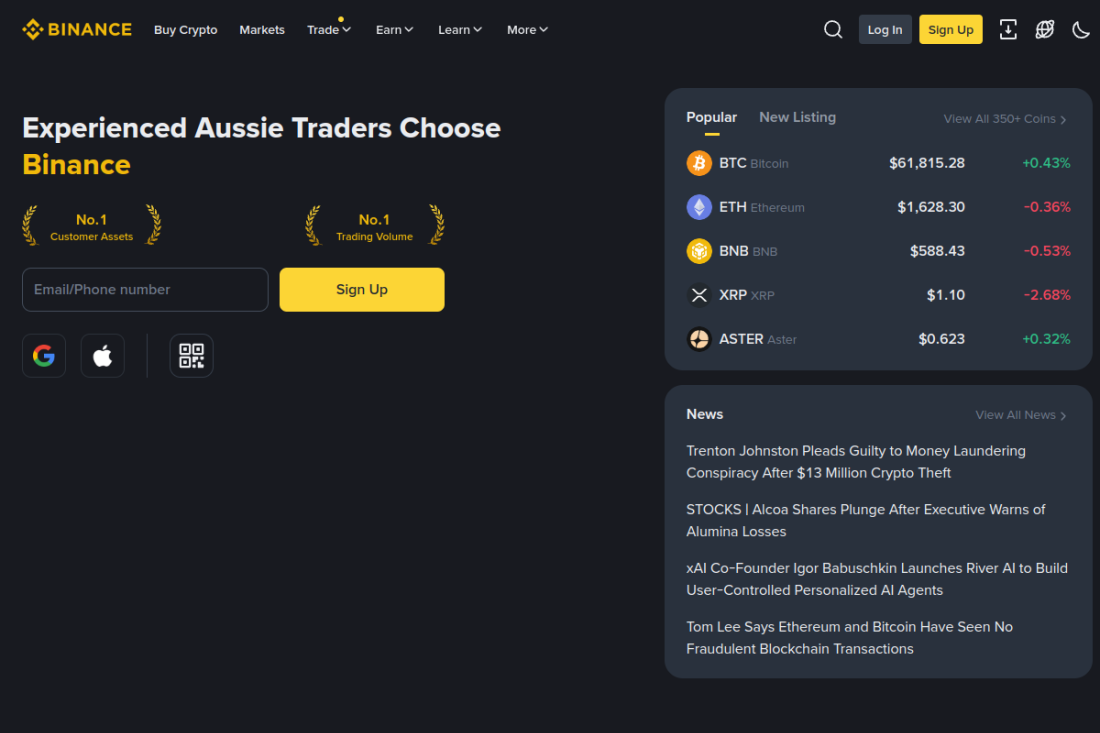
Trading fees, subscriptions, deposits and withdrawals
Spreads, deposit caps and charges that do not appear on a fee page
Assets, Australian dollar pairs, staking and derivatives
Custody, reserves, insurance and self-custody
Entity types onboarded in Australia
Order types, recurring buys, tooling and access
Minimums, methods and settlement speed
What you get at tax time, and what you do not
Apps, account security and how you reach a human
The entity you are actually contracting with
Figures are read from Binance's own published schedules and disclosures. Crypto platforms change pricing and product availability often - click source on any row to check it yourself, and dispute anything that looks wrong.
Yes, for spot trading. The local entity is AUSTRAC-registered. Derivatives are not available to Australian retail clients after the 2023 licence cancellation.
Not by PayID or bank transfer at the time of writing. The 2023 loss of its payments partner means card purchases and P2P are the main AUD routes; many users buy on a local exchange and transfer crypto in.
In December 2024 ASIC commenced proceedings against Binance Australia Derivatives, alleging retail clients were misclassified as wholesale and lost consumer protections. The case concerns the now-closed derivatives business.


