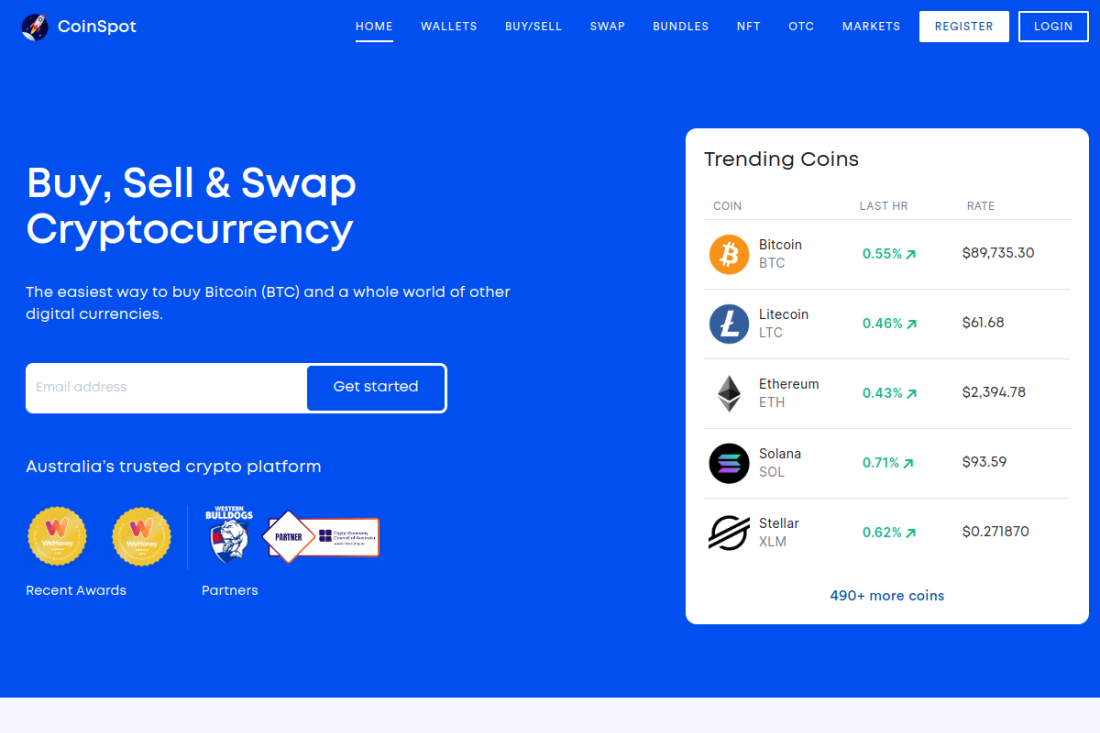
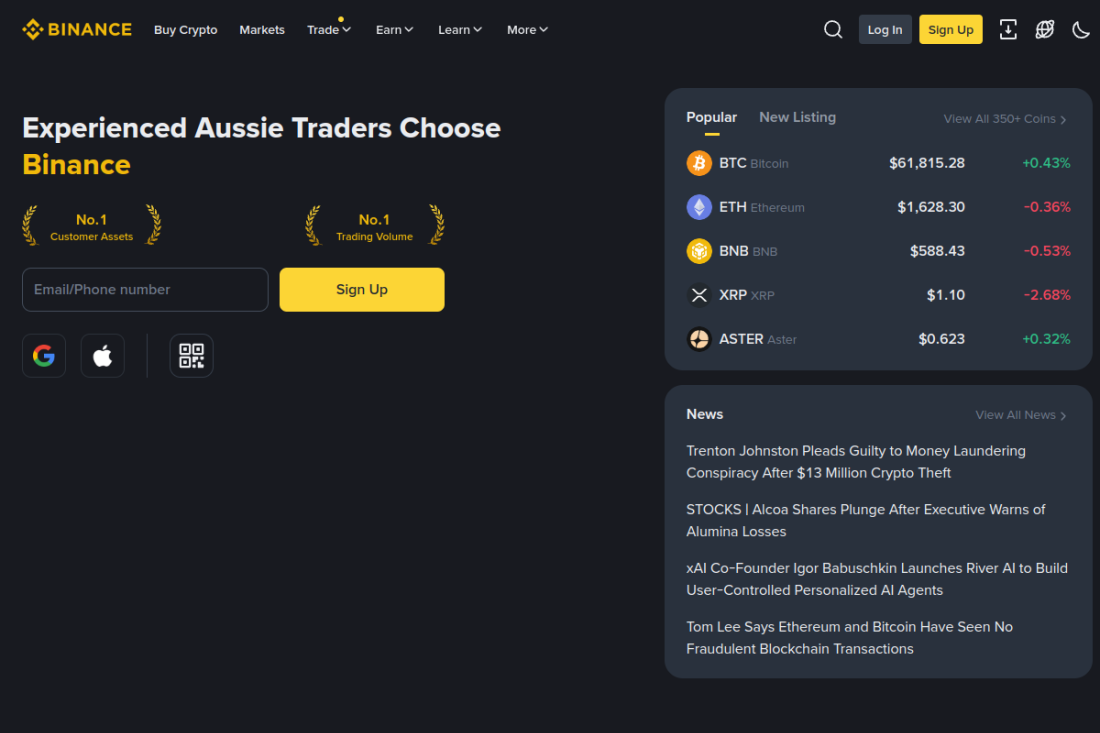
Binance runs the deepest order book in crypto. CoinSpot runs the widest AUD-priced catalogue in Australia. For an Australian buying in AUD, that difference decides which one is actually cheaper.
Trade on Binancebinance.com
Trade on CoinSpotcoinspot.com.au
Both links are affiliate links. They never change the ranking, the scores or the data on this page.
Three costs kept apart, because they are not the same thing: the published trading fee, the AUD conversion a venue with no AUD book forces on you, and the measured cost of crossing its order book. Click any route for the detail.
Execution. No book involved. Binance quotes a rate and the margin is inside it, so there is no spread to cross and no fill risk.
With no AUD order book, an AUD buy is priced off a quote rather than charged a visible fee. The 1% is the desk's modelled figure from the exchanges table, not a published rate, and it is the least certain number on this page.
Execution. Crosses the Binance BTC/USDT book, the deepest in crypto. Measured execution cost on this size is nil.
The 0.075% is Binance's real spot fee and it is the best in the market. What makes this route expensive from Australia is getting there: every AUD pair including AUDUSDT has been halted since 1 June 2023, so AUD has to be converted off-book first. Already holding USDT? Ignore the conversion column and this route costs 0.075%.
Execution. Priced by quote. CoinSpot's buy/sell gap sits on top of the 1% and is not published as a rate, so the true all in is above the figure shown.
The default interface, and for most of CoinSpot's catalogue the only one. A flat 1% per trade, each way. CoinSpot does not disclose its Instant quote spread, so this figure is a floor rather than a ceiling.
Execution. Crosses the CoinSpot BTC/AUD book. It is thin and one-sided: at the last reading a single resting order was most of the sell side. Crossing costs more than the fee does.
The 0.1% is the fee alone, on 16 advertised pairs. Measured against CoinSpot's own 1% Instant Buy, only 6 of those pairs actually come out cheaper once you cross the book. This route works for BTC, ETH and a handful of majors, in small size.
Binancebuying
A$10.1m
4%0.000%0.000%0.000%0.000%0.000%0.000%
Binanceselling
A$14.0m
3%0.000%0.000%0.000%0.000%0.000%0.000%
CoinSpotbuying
A$300k
33%0.101%0.101%0.101%0.146%0.209%too big
CoinSpotselling
A$186k
54%0.102%0.112%0.114%0.115%too bigtoo big
CoinSpot advertises a 0.1% fee on its Markets order book, against 1% on Instant Buy. The fee is real. The cost is the fee plus crossing the book, and on most of these pairs the book is barely there. Every pair below was walked on 26 July 2026 at a A$1,000 order.
Buy majors in AUD on CoinSpot, in small size. Trade on Binance.
They are not competing for the same job. CoinSpot is a door into crypto priced in AUD. Binance is a trading floor you can only reach by converting first. The catch is that CoinSpot's cheap route depends on an order book that, on most pairs, is barely there.
CoinSpot Markets
CoinSpot Instant, at 1%
Binance
Binance, or a CoinSpot OTC quote
CoinSpot
CoinSpotOrder book depth is the least stable thing on this page and the easiest to check: the figures above are one snapshot and CoinSpot's books are thin enough to change character in an hour. Two structural things would change the call. Binance listing a genuine AUD pair would remove the conversion at a stroke. CoinSpot's licence widening beyond non-cash payment products would change its standing. Binance's no-action relief expires 30 September 2026; CoinSpot has published nothing past FY23.
For a small AUD buy of BTC or ETH, CoinSpot. Its Markets book puts those near 0.25% all in, against roughly 1.08% for the cheapest Binance route, which has to pay an AUD conversion first. That advantage is narrow though: it holds for 6 of the 16 pairs CoinSpot advertises at 0.1%, and only while the order is small enough for the book to absorb. Once you already hold crypto, Binance is far cheaper and its execution is in a different league.
No. Binance delisted its remaining AUD pairs on 1 June 2023 and has not relisted them. Its public API still returns a halted status for all 30 AUD symbols. PayID and bank deposits were restored on 16 January 2026, but that restored funding, not markets - AUD is a funding currency on Binance, not a trading currency.
On the fee alone, yes: 0.1% against 1%. On what leaves your account, usually not, and often the reverse. Markets is an order book and you have to cross it. We walked all 16 pairs CoinSpot advertises at 0.1%: only 6 came out cheaper than its own 1% Instant fee at a A$1,000 order. ADA was about 3.9% all in, DOGE 2.5%, and EOS could not fill A$1,000 on either side. On BTC, where it does work, the real gap is about three times rather than ten. You can avoid crossing the spread by posting a limit order, but then you are waiting on another CoinSpot customer who may not arrive.
Less than most people expect. At the last reading its deepest AUD book, BTC, held about A$256,000 of asks and A$127,000 of bids, and 79% of that bid side was one resting order. A few thousand dollars crosses it fine. Ten thousand starts to move it. Past about a quarter of the visible depth we stop quoting a cost on this page, because the price the book implies is not the price you would get. For larger orders use the OTC desk, which quotes from A$20,000, or split the order over several days.
CoinSpot. Both are AUSTRAC-registered, but CoinSpot also holds AFSL 562554, granted in April 2026 - though that licence covers non-cash payment products, not crypto dealing itself. Binance Australia has no AFSL and operates under ASIC class no-action relief that expires on 30 September 2026. Binance's derivatives entity was ordered to pay a A$10 million penalty in March 2026.
CoinSpot lists over 480 coins against 471 verified live base assets on Binance, so they are close. The difference is pricing: every CoinSpot coin is buyable in AUD at 1%, and only 16 get the 0.1% rate. On Binance all 471 trade at the book rate, but none of them against AUD.
Both onboard self-managed super funds. CoinSpot has a dedicated SMSF path with its own support team and EOFY reporting built for fund audit obligations. Binance handles an SMSF through its general entity account process, with no SMSF-specific reporting documented.
They protect you in different ways. Binance publishes a self-verifiable Proof of Reserves and holds a roughly US$1 billion SAFU fund, though SAFU is discretionary rather than insurance. CoinSpot publishes unqualified external statutory audits (FY21 to FY23) and is ISO 27001 certified, but has no Proof of Reserves and nothing published past FY23. Neither balance is covered by any government guarantee.
It is a common pattern. CoinSpot is the cheaper and simpler AUD on-ramp and off-ramp, with same-day free withdrawals. Binance is the cheaper venue once you are trading crypto against crypto. Moving coins between them costs a network fee, so it is only worth the extra step if you trade often enough for the fee gap to cover it.
Binance, by a distance. We walked both public books on the same day, both sides. Binance BTC/USDT showed a 0.0000% touch spread with A$9.8m of asks and A$14.8m of bids, no measurable slippage at any size to A$100,000, and no single order larger than 3.5% of the book. CoinSpot's BTC/AUD showed A$256,000 of asks and A$127,000 of bids, with a single resting order making up 79% of that bid side. Depth that is one order is depth that can leave.
Binance
CoinSpot